
Introduction: The Automation Imperative and the Foundational Role of Power
The global manufacturing sector is experiencing one of the deepest transformations, witnessing the shift from Industry 3.0, with its static, wired, logic, to the dynamic and data-driven ecosystem of Industry 4.0, which is driving digital transformation. It is not a matter of choice, but a necessity stemming from global competition, widening skills gaps, and rising labor costs, which pose a significant challenge for manufacturing companies. Hence, manufacturers must optimize their production processes focusing on flexibility, efficiency, and sustainability to meet evolvingmarket demands.
To flourish within these new parameters, smart factories and smart manufacturing facilitiesneed to be smart and flexible to the point of autonomously making decisions. This vision requires the adoption of AI and advanced technologies. There are a few, but powerful, technological innovations leading to the 5 Essential Factory Automation Trends that are paradigmatic to the evolution of manufacturing in the coming years.
Most of the time we emphasize artificial intelligence, Mobile Robotics, and cloud computing, the upper-level digital parts of the control systems and communication system of the factory. These are key technologies for future growth. But the actual factory floor calls for basic implementation: movement must be created, regulated and executed in a dependable way. This is the domain of basic automation technologies. Although usually neglected in the technological discussions, the contemporary pneumatic system, powered by compressed air, is the basic provider of physical implementation and control to a multitude of industrial operations. The future of automation must address, in extensive detail, the vital components that allow automation solutions to bridge the digital and physical realms of control. Furthermore, embracing the Industrial Internet of Things (IIoT) is crucial for achieving operational efficiency.
I. Trend Analysis: Intelligence and Connectivity Drive the Modern Factory
The most important feature of the smart factoryis the ability to learn and perform actions on the basis of real time information. This demand of connectivity and awareness has now been applied to all the components including the most established equipment on the shop floor. Achieving this intelligence requires robust data analytics and sophisticated AI systems.
Trend 1: AI-Driven Predictive Maintenance and Optimization
The shift towards reactive, scheduled maintenance and the actual predictive maintenance is a significant step in the efficiency of operations, helping avoid costly equipment failures. Maintenance events are no longer unexpected expenses but foreseeable activities. Combining the analytical capabilities of machine learning (ML) algorithms and predictive analytics with the communication network of the Internet of Things (IoT)/ Industrial Internet of Things (IIoT), facilities will be able to track the health of machines and anticipate failures long before they happen. This also enables robust quality control.
Pneumatic Association: The Sensor-Ready System.
In the case of pneumatic systems, which are a part of many industrial applications in clamping, lifting, and pressing, it is necessary to integrate intelligence. The difficulty lies in making sure that these trusted elements are not isolated data points in the networked factory. The use of smart sensors is key here.
Smart Pneumatic Components is the answer. Existing valve terminals and actuators are designed with inbuilt or compatible smart sensors (measuring pressure, flow and temperature). These sensors send vital operational information, including cycle time changes or sudden pressure drops, directly to the IIoT gateway, often utilizing edge computing for fast local processing. This data is processed by an AI platform to conduct diagnostics, detecting minor deviations that indicate component wear or possible failure. This feature allows accurate scheduling of component replacement, which guarantees the highest level of operational availability and significantly contributes toprocess optimization.
Trend 2: The Rise of Collaborative Robotics and Agile Production
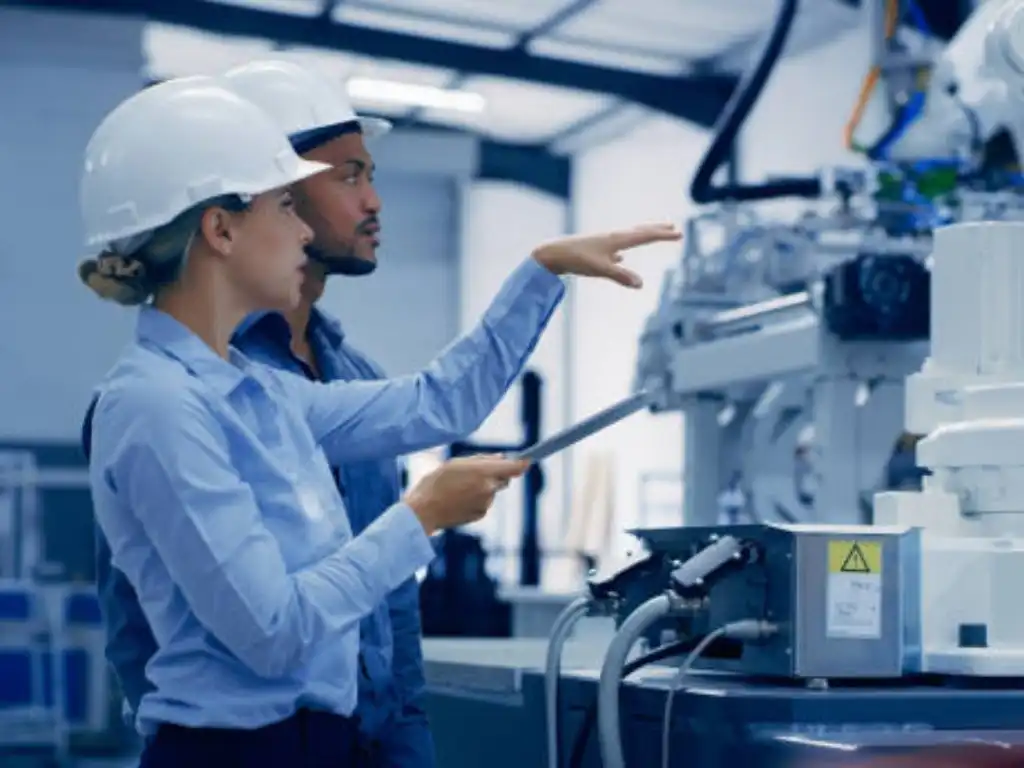
The idea of traditional industrial robotscompletely substituting human workers has evolved into the deployment of collaborative robots (Cobots). These machines are made to operate safely in direct contact with human workers and new employees, increasing productivity without a lot of safety barriers. At the same time, autonomous mobile robots (AMRs) are simplifying logistics and material handling, dynamically moving materials according to optimized production schedules. Such a production environment demands flexible, fast, and secure end-of-arm tooling (EOAT) and is a prime example of industrial automation.
Pneumatic Association: Accurate Gripping and Rapid Response
EOATperformance is the most important in very agile production environments. While electric servo grippers provide fine control of force and position, pneumatic grippers and vacuum cups have their own operational benefits, especially when the product changeovers are high. Pneumatic solutions have a better gripping force-to-weight ratio, which enables Cobots and other industrial robots to carry heavier loads or work within the best velocity range. Their high-cycle, reliable operation is very well adapted to pick-and-place, assembly lines, and packaging of consumer products and industrial products. Importantly, the simplified air connection allows quick tool changes, which is in line with the essence of the flexiblerobotic systems applications. Vision systems are also increasingly used to guide these robots with precision.
II. Trend Analysis: Sustainability and Modularity Reshape System Design
The future factory should be very flexible and responsible to the environment. These two aspects, design agility and environmental responsibility, are driving fundamental changes in component specification and system architecture. Furthermore, addressing cybersecurity risks is paramount as connectivity increases.
Trend 3: Software-Defined Automation and System Modularity
Manufacturers are abandoning fixed production lines that are rigid and expensive to change. Market demandsfor agility necessitate production cells that can be reconfigured quickly. This motivates the adoption of a Software-Defined Automation strategy, in which physical hardware is modular and its operational parameters are specified by software control in a centralized manner using process automation techniques.
Pneumatic Association: Flexibility of Valve Island and Central Control
This modular paradigm is easily supported by the pneumatic system by the creation of the Smart Pneumatic Valve Island. These new terminals are advanced networked control centers. They have built-in fieldbus interfaces (such as EtherCAT, PROFINET, and Ethernet/IP) and can be centrally programmed and controlled through the main industrial network, often communicating via protocols like OPC UA. This enables the supervisors to make quick changeovers to new product runs by changing the pressure, flow and timing of the connected actuatorswithin a production cell- all digitally controlled. This renders the pneumatic system a fundamental component of plug-and-produce modularity, which is key to achieving a competitive edge. Programmable logic controllers (PLCs) remain central to these control systems.
Trend 4: The Sustainability Mandate and Energy Efficiency
Sustainability is no longer a PR issue, but a fundamental financial and regulatory requirement. With the high cost of energy and environmental policies, manufacturers are focusing on energy consumption and energy efficiency in all their industrial operations. The shift to renewable energysources is also gaining traction. In the case of the pneumatic system, which has traditionally been linked to energy loss due to leakage of compressed air, this is a major challenge and a powerful motivation to technological improvement.
Pneumatic Association: Leak Management and Energy-Optimized Solutions
The contemporary, high efficiency pneumatic system is a direct response to the sustainability requirement. The major technological solutions include high-tech air preparation and control optimization:
- Proportional Pressure Control Valves make sure that actuators only get the required pressure to do their job, and no energy is wasted due to over-pressurization.
- Zero-Leakage Technology in seals and valves, along with constant IIoT monitoring, enables automatic, real-time leakage detection.
With these optimized solutions in place, pneumatic systemscan make a substantial contribution to their energy profile and deliver measurable benefits to lowerenergy consumption.
III. Trend Analysis: The Digital Twin and Virtual Commissioning
The need to be fast and efficient in project implementation has resulted in the widespread implementation of the digital twin, which is a full-scale virtual representation of a real system. It is a technology that enables the simulation, testing, optimization and commissioning of complete assembly lines and production processes in a virtual environment without any physical hardware being installed. This removes costly mistakes, shortens start up time, and enables quick testing of what-if scenarios.
Trend 5: The Digital Twin and Simulation-Driven Design
The complexity of modern manufacturing technologyrequires the shift away from slow physical prototyping. The fifth critical trend is the Digital Twin, which allows engineers to design, test, and virtually commission complete systems, including mechanical motion, sensor logic, and communication protocols, reducing the time-to-market by orders of magnitude and increasing the success rate of first-run. This is especially vital for smaller companies looking to compete.
Pneumatic Association: Virtual Component Modeling and Validation
To be effective, the operational characteristics of each component should be modeled by a physics-based model. Unlike legacy systems, modern pneumatic componentsare provided with validated simulation models (CAD, E-CAD, and functional libraries). These models are a good representation of:
- Dynamic Response: The rate of change of an actuator with pressure and load.
- Energy Consumption: Accurate determination of air consumption at various cycle times and forces.
- Control Logic: Timing and flow properties of smart valve islands.
Through these accurate digital resources, engineers are able to model complicated pneumatic programs, including robotic systems gripping actions or coordinated press cycles, in the Digital Twin setting. This guarantees that the physical pneumatic systemis performance and energy efficient prior to the installation phase, which is a direct link between virtual design and physical implementation, further enhancing process optimization. Emerging fields like generative AI and the ability to process natural language are also starting to impact the design and programming of these systems.
Pneumatics as the Engine of the Future Factory

The five key trends in factory automation, which include Intelligent (artificial intelligence-driven) (1), Collaborative Agility (2), Modularity (3), Sustainability (4), and Digital TwinValidation (5) are radically transforming manufacturing and creating new opportunities. Although the strategy can be facilitated by digital technologies, physical implementation needs strong and advanced execution systems. This transformation relies heavily on data analytics and having enough skilled workers and skilled labor to manage the systems. Improving employee satisfaction is also an integral part of this transition.
The contemporary pneumatic element is a developing manufacturing technology. It has been able to go through a colossal upgrade, making it smarter, cleaner, faster, and more deeply integrated than ever. It is the required linkage between the digital command center of the factory and the physical output, which is the key driver that provides the force, speed, and flexibilityneeded to achieve long-term success in Industry 4.0 and build supply chain resilience. Not considering the current potential of pneumatics is to overlook an important aspect of future-proofing your manufacturing process.Thefuture of industrial automationhinges on this integration.
Leveraging Pneumatic Expertise: Our Solution to Automation Challenges
Our expertise is focused on translating the technical advantages of advanced pneumatics into practical operational benefits, directly resolving critical pain points arising from the new automation environment:’
Operational Cost Issues Energy consumption and operational costs are key areas that many factories need to optimize. HEBAI’s pneumatic products use advanced flow control technology and high-efficiency sealing designs to effectively reduce energy consumption and improve overall system efficiency. Our products, with filtration accuracy ranging from 25–40 μm and flow rates between 500–4000 L/min, optimize air circuits and flow path designs, helping customers achieve significant cost savings over the long term. Our solutions provide clear energy-saving commitments and ROI analysis, ensuring your investment delivers greater value.
Flexible Manufacturing Faced with ever-changing production demands and personalized customization requirements, HEBAI offers strong customization capabilities. Our cylinders, valves, and FRL units come in a wide range of options, from standard sizes (cylinder diameters ranging from Ø12 to Ø320 mm and stroke lengths from 10 to 2000 mm)to large specifications, and support flexible configuration. Whether for Cobots or customized production lines, we can provide one-on-one technical support and solution design based on your specific needs, ensuring your production line is not only efficient but also adaptable to constantly changing market demands. Our fast delivery cycles and strong engineering collaboration capabilities enable customers to quickly upgrade their production lines in a short time.
Leveraging Pneumatic Expertise: Our Solution to Automation Challenges In the digital age, seamless integration of industrial systems is crucial for efficiency and cost reduction. HEBAI’s pneumatic products offer precise pressure regulation (0.1–1.0 MPa), filtration (25–40 μm), and lubrication, ensuring stable and reliable operations. With modular designs, our products can easily integrate into existing automation systems across industries such as manufacturing, automotive, food & pharmaceuticals. With high compatibility, our systems support real-time monitoring and automation, reducing energy consumption and maintenance costs. Through continuous innovation, our solutions drive smarter, more efficient production lines, helping businesses achieve their digital transformation goals.
Is your current pneumatic infrastructure positioned to support your automation future, or is it creating hidden inefficiencies? If you have any questions, please feel free to contact us for assistance.
Powering the Future of Automation Through Intelligent Pneumatics
The five essential factory automation trends—Intelligence, Collaborative Agility, Modularity, Sustainability, and Digital Twin Validation—are impacting the operations and competition in the manufacturing sector. Although there are several digital technologies there to coordinate and control, the full realization of Industry 4.0 will also require sophisticated physical systems that can translate digital commands to dependable mechanical actions.
Modern pneumatics. Smarter, cleaner, and faster than ever before, modern pneumatic systems now bridge the final gap between digital intelligence and physical execution. The pneumatics of modern systems meet the motion, accuracy, and flexibility for adaptive manufacturing environments. Failing to recognize sophisticated pneumatics systems puts you on the wrong side of modernity in manufacturing.
Contact us to learn about the sophisticated pneumatic systems that will mark the beginning of your factory automation to seamless and sustainable progression to the future.

 English
  Spanish
  French
  Russian